Bidini Table Hockey


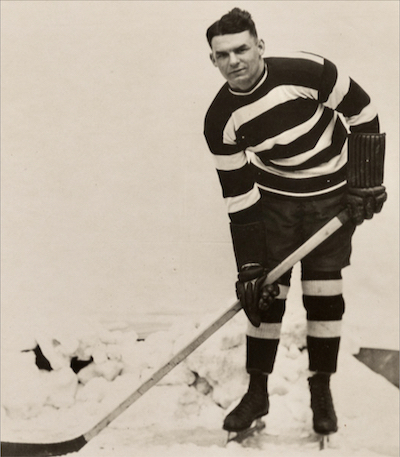
Tex White. Source.
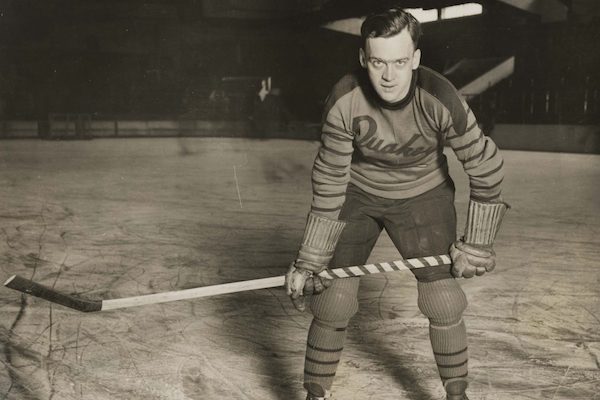
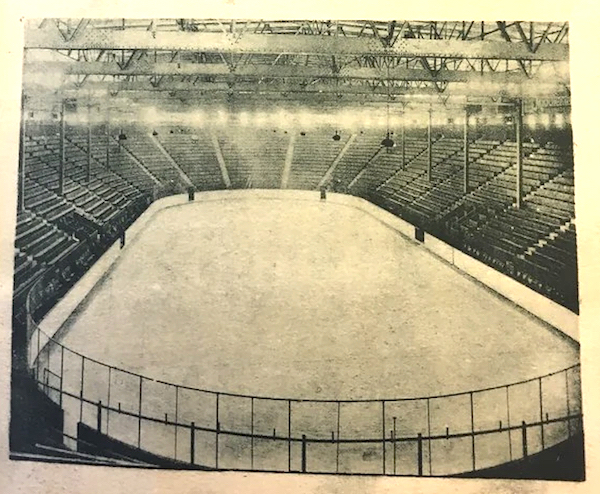
The Senators visited the Quakers at the Philadelphia Arena. The Quakers themselves were new to the place, having just relocated from Pittsburgh where they had played five seasons as the Pirates.
The Ottawa Citizen (March 4, 1931, p. 11) referred to the Quakers as “the second Ottawa team”. The Quakers’ Harold Darragh, Syd Howe, Wally Kilrea, Gerry Lowrey, Ren Manners, Al Shields and Rodger Smith had all played in the Ottawa City Hockey League, Darragh, Howe and Smith for the Gunners, Kilrea, Manners and Shields for the Montagnards, and Lowrey for the University of Ottawa.
Syd Howe had started out at Glebe Collegiate, then moved up to the Gunners. In 1929-30 he played for the Senators and the IHL ‘s London Panthers. After the Quakers folded the Leafs picked him up but sent him to the IHL Syracuse Stars. He was back with the Senators for their final two seasons and accompanied them to St Louis when the became the Eagles. After they folded the Red Wings took him on, and Detroit is where he made his name. He played twelve seasons with them and won three Stanley Cups. His last stop was with the Ottawa Senators of the QSHL in 1946-47.
Phiadelphia’s head coach was Cooper Smeaton, originally from Carleton Place. He left his post as NHL referee-in-chief to take up the job. After one season behind the bench he went back to refereeing. He was made a Stanley Cup trustee in 1946 and was inducted into the Hockey Hall of Fame as a referee in 1961.
Scoring:
First period: no scoring.
Second period: goals by Hec Kilrea (Ottawa) and Harold Starr (Ottawa).
Third period: goals by Cliff Barton (Philadelphia) and James Jarvis (Philadelphia).
Final score: 2 – 2.
Montreal Senior Group:
Game 3, November 17: McGill 2 – 0 Victorias
Game 4, November 17: Canadiens 1 – 3 Montreal AAA

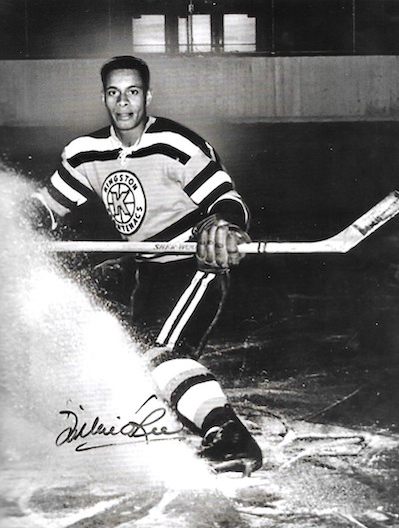
Willie O’Ree became the NHL’s first Black player on January 18th, 1958 when he suited up for the Boston Bruins in a game against the Montreal Canadiens. By 1959-60 he was a Kingston Frontenac in the EPHL. But during the 1960 offseason he was transferred from Kingston to the Hull-Ottawa Canadiens, though still a Bruins property. On November 13th, 1960 the Frontenacs visited Hull-Ottawa at the Hull Arena.
First period: goals by Maxwell (Kingston) and O’Ree (Hull-Ottawa);
Second period: goals by O’Ree (Hull-Ottawa) and Locas (Hull-Ottawa);
Third period: goal by Panagabko (Kingston).
Final score: Hull-Ottawa 3 – 2 Kingston
O’Ree’s performance must have impressed the suits because on November 19th he was back up with the Boston Bruins.
Past and future Bruins on the 1960-61 Frontenacs team were Dick Meissner, Carl Boone, Don Blackburn, Orval Tessier, Tommy Williams, coach Harry Sinden, Real Chevrefils, Lorne Ferguson, Gerry Ouellette, Barry Ashbee, Charlie Burns, Ted Green, Jeannot Gilbert, Floyd Hillman, Ed Westfall, Harry Lumley and John Henderson. The Frontenacs’ home rink was the Kingston Memorial Centre on York Street, built in 1950 and still standing.
Willie O’Ree entered the Hockey Hall of Fame in 2018 and recently celebrated his 90th birthday.

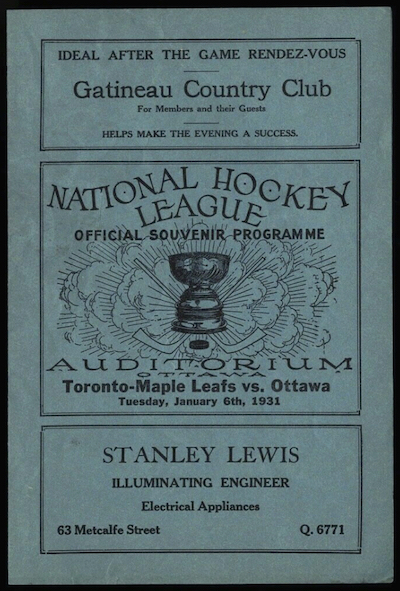
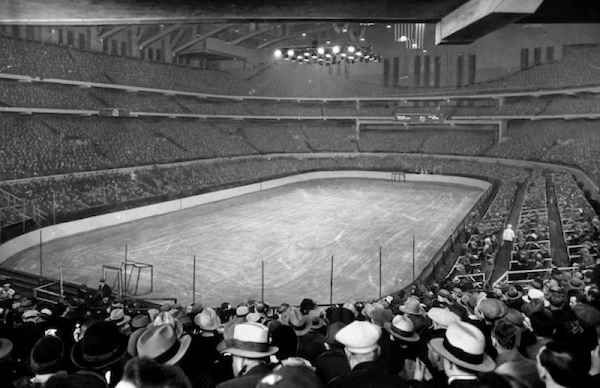
The Montreal Maroons and Ottawa Senators opened their 1930-31 seasons with a game at the Ottawa Auditorium, at the intersection of O’Connor and Argyle Streets. The Aud had been built in 1923 to replace Dey’s Arena over beside the Rideau Canal, and it retained a peculiarity of the older rink: semi-circular end boards. Most hockey rinks are playing-card shaped, a rectangle with rounded corners. But the Aud had no flat surfaces behind the goal, making it “a bitch to play defence in” as one old guy told me.
Of the Senators’ sixteen players, nine were from Ottawa itself and two more were from the Ottawa Valley. Ten had played in the Ottawa City Hockey League, which was at the time one of the NHL’s major sources of talent. Bill Beveridge had played for the Shamrocks and the New Edinburghs; Connell for the Cliffsides, St Brigid’s and Gunners; Connor, Grosvenor and Kilrea for the Rideaus; Finnigan for the Montagnards; Kinsella for the Shamrocks and Rideaus; Alex Smith for the Gunners and Rideaus; Starr for the Gunners, St Brigid’s and Shamrocks; and Touhey for the St Brigid’s, Gunners and Montagnards.
Though many Ottawa Senators have gone into the Hockey Hall of Fame, none of them were on the 1930-31 team.
The 1930-31 Maroons squad had fifteen players from Ontario and only three from Quebec. This was Anglophone Montreal’s club; the Habs were for the Francophone fans. Eight Maroons had played in the Montreal City Hockey League: Brydson, Gallagher and Haynes for the Montreal AAA; Roche and Wilcox for the Victorias; Huggins and Kerr for the CPR and AAA; and Boucher for La Casquette. Nels Stewart, Babe Seibert and Hooley Smith are in the Hockey Hall of Fame. For a complete history of the Maroons see William Brown’s The Montreal Maroons: The Forgotten Stanley Cup Champions.
First period: goal by Hec Kilrea (Ottawa).
Second period: goal by Danny Cox (Ottawa).
Third period: no scoring. Three major penalties.
Final Score: Senators 2 – 0 Maroons.
Let’s follow the 1930-31 Montreal Senior Group, which begins play this week. There are five teams: Columbus, Canadiens, Victorias, AAA, and McGill. A double bill is played each Monday night at the Forum:
Game 1, November 13: Columbus 2 – 1 Canadiens
Game 2, November 13: Victorias 1 – 2 AAA


The Royals were 1959-60 EPHL champions.
The Eastern Professional Hockey League was a minor pro hockey league that operated for four seasons from 1959 to 1963 and served as a farm system for the NHL. During its first three seasons the league was made up of six teams, all of them in Canada. The Hull-Ottawa Canadiens were a Montreal Canadiens farm club. They played at both the Arena de Hull and the Ottawa Auditorium, hence the club’s hyphenated name. They had been part of the OHA Senior A league for three years before the creation of the EPHL, coached by such future luminaries as Sam Pollock and Scotty Bowman. Many Montreal Canadiens players of the 1960s came up through Hull-Ottawa. The Royals were the offspring of the venerable Montreal Amateur Athletic Association, the original Stanley Cup champions. By the early 1930s the MAAA could no longer support all its sporting departments, so the men in charge of the hockey team spun it off under the name Royal Montreal Hockey Club. They played in the Montreal Senior Group from 1932 to 1937, the Quebec Senior Hockey League from 1937 to 1953, the Quebec Hockey League from 1953 to 1959, and were founding members of the EPHL in 1959. The Royals roster was also loaded with future Montreal Canadians. Like the NHL the EPHL played a 210-game schedule, or 70 games per team, spread over five-and-a-half months, followed by about a month of playoff games. The EPHL’s championship trophy (see it above) was the Tom Foley Memorial Trophy, named after an Ottawa broadcaster who was killed in a car crash in 1959.
October 6th was the 1960-61 season opener. The Royals visited the Hull-Ottawa at the Hull Arena.
First period: goals by Rousseau (Hull), G. Tremblay (Hull);
Second period: goals by Gray (Hull), Connelly (Royals);
Third period: goals by Skov (Hull), Pennington (Hull), O’Ree (Hull), Grigg (Royals), G. Tremblay (Hull).
Final score 7 – 2. Attendance 2,367.
Referee: Matt Pavelich.