Louise, Oregon City


The Ottawa Senators visited the Detroit Falcons at the Olympia on this date in 1931.
Detroit entered the NHL in 1925 stocked with Victoria Cougars from the defunct WCHL. They played their first season at the Border Cities Arena in Windsor, Ontario while the Olympia was being built. They called themselves the Cougars for the first four seasons, then rebranded as the Falcons in 1930, and the Red Wings in 1932.
Which Victoria Cougars were still with Detroit in 1930-31? Only Winnipegger Frank Frederikson, and he was returning from spells with Boston and Pittsburgh.
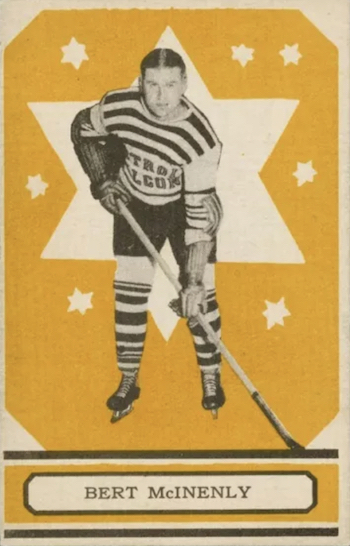
There were several Ottawa players on the Falcons roster. Ebbie Goodfellow was a former Montagnard. Bert McInenly had played for the Rideaus, Shamrocks and Gunners. Stan McCabe was a Gunner and a Rideau in the Ottawa city junior league. Hal Hicks played for pretty nearly all the Ottawa teams between 1916 and 1926. John Newman was a junior Shamrock. Harvey Rockburn was a Tiger, a Gunner and a Shamrock.
The Senators’ goalie Bill Beveridge was a Detroit Falcon in 1929-30. He began as an Ottaa Shamrock in 1924-25 and finished off his career as an Ottawa Commando in 1944-45.
First period: goal by Herbie Lewis (Detroit).
Second period: no scoring.
Third period: goal by Goodfellow (Detroit).
Final score: Detroit 2, Ottawa 0.
Montreal Senior Group:
Game 29, February 9: Columbus vs Victoria
Game 30, February 9: Canadiens vs Montreal AAA
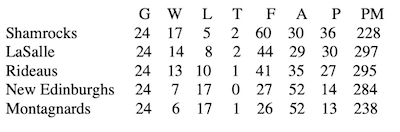
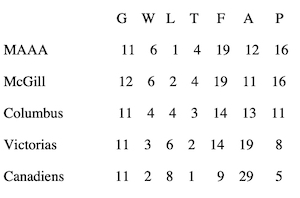
These last two games were not played, as the three playoff teams were already decided and because McGill wanted to fit in an exhibition game against Harvard. In pursuit of that potentially huge box office McGill agreed to waive their claim to first place and with it a bye through to the final. So the final standings were:


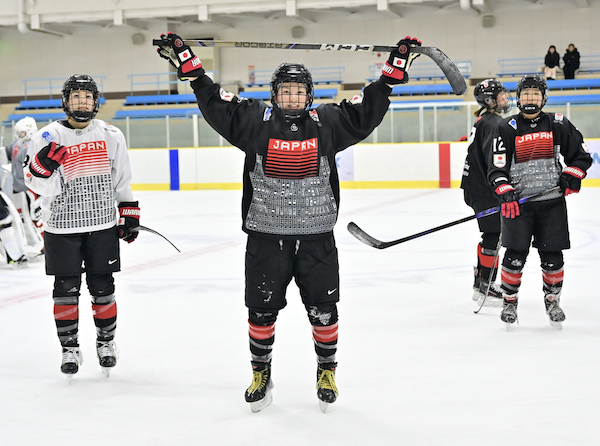
It’s the Winter Olympics. Let’s follow the Japan women’s team, who are ranked 8th in the world. They’ll play in Group B against Germany, Sweden, Italy and France.
Group stage:
2026/2/6 France [2 – 3] Japan
2026/2/7 Germany [5 – 2] Japan
2026/2/9 Japan [2 – 3] Italy
2026/2/10 Japan [0 – 4] Sweden
The five Group A and top three Group B teams advance to the quarter-finals.
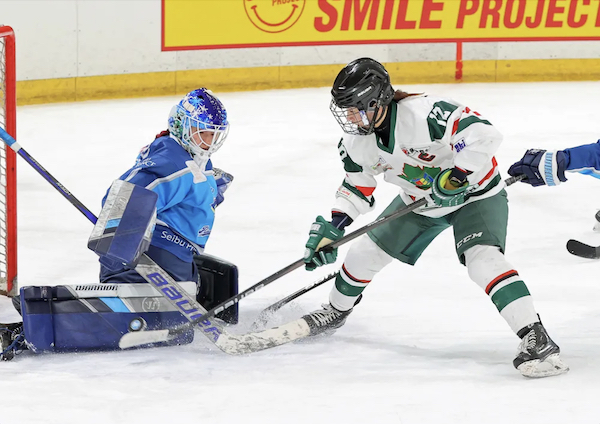
The Japanese team has seven players from the Daishin roster, six from Peregrine, three from Seibu Princess Rabbits, three from Toyota Cygnus, two who play for Linköping, one for Luleå, and one for Järnbrotts HK.
[Japan finishes fourth in Group B, ninth overall, and misses the quarter-finals.]

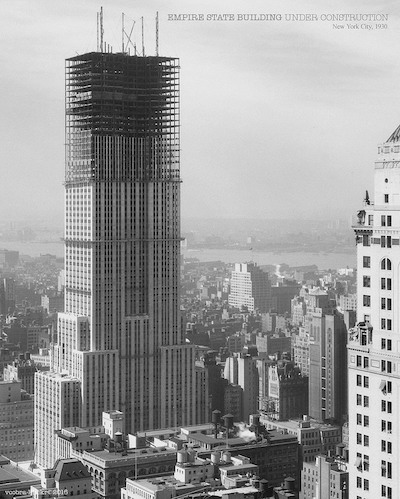
They were raising the Empire State Building during the 1930-31 NHL season. Source.
The New York Americans visited Ottawa on February 3rd, 1931. The Amerks were fourth in the Canadian Division with 29 points, Ottawa fifth with 12.
The NHL had been divided into Canadian and American divisions in 1926 and from the start the New York Americans were part of the Canadian Division. You would hope that Dorothy Parker or Alexander Woollcott made some kind of remark about it. Why put the Amerks in the Canadian Division and not, say, Detroit? What was the strategy behind having teams from both divisions in Madison Square Gardens but two Canadian Division teams in the Montreal Forum?
A Madison Square program of the time advertises “Games every Tuesday, Thursday and Sunday night”. Saturday has never been hockey night in the USA. But Saturday was not hockey night in Ottawa either. In 1930-31 the Senators played thirteen home games on Thursday, six on Tuesday and only two on Saturday.
Yip Radley was the only Ottawan on the 1930-31 Amerks roster, and he only appeared in one game (not tonight’s). He spent the rest of the season with the Can-Am League New Haven Eagles. He had played for the Rideaus and Montagnards in the Ottawa City Hockey League. He later played 17 games for the Montreal Maroons in 1936-37.
The Senators’ Harry Connor played for the Amerks in 1928-29.
First period: goals by Kilrea (Ottawa), Cox (Ottawa), Ayres (Amerks) and Carson (Amerks).
Second period: goals by Burch (Amerks) and Sheppard (Amerks).
Third period: no scoring.
Final score: New York Americans 4, Ottawa Senators 2.
Montreal Senior Group:
Game 25, January 26: Columbus 1 – 1 Montreal AAA
Game 26, January 26: McGill 4 – 1 Canadiens
Game 27, February 2: Columbus 3 – 0 Canadiens
Game 28, February 2: McGill 2 – 2 Victorias

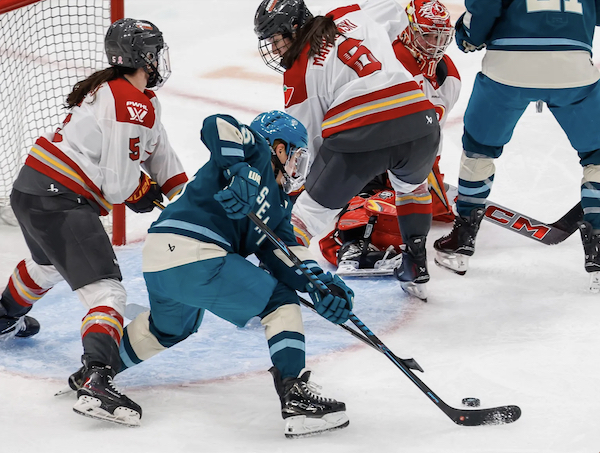
The Torrent visit the Charge. Ottawa is sixth in the league with 19 points, Seattle eighth with 16. The December 17th game between these two teams in Seattle ended in favour of the Torrent by a score of 4 to 1.
Nearly everyone on the Seattle roster has played for some other PWHL club before. Mikyla Grant-Mentis and Lexie Adzija are both on their third PWHL club. The most travelled player must be Aneta Tejralová who has played for Ottawa in the PWHL, MoDo in the SDHL, Boston Pride of the old PHF, SKIF Nizhny Novgorod and Dinamo St Petersburg of the Russian league, and Slavia Prague of the Czech league. In all, Seattle have five former Ottawa Charge players on their roster: Adzija, Grant-Mentis, Tejralová, Danielle Serdachny, and Natalie Snodgrass.
The Torrent play at the Climate Pledge Arena, aka Seattle Center Coliseum, built in 1962, with seating for 17,000. It’s also the home rink for the Seattle Kraken. Their lowest attendance so far has been 8,622; highest 16,014. Seattle is one of the natural hometowns for pro hockey and it’s crazy that the NHL has only just moved in there. The 1919-20 Stanley Cup final was between Ottawa and Seattle.
[Ottawa 4, Seattle 2]

Despite everything you might have heard on the CBC, the oldest and best hockey rivalry in the world is Ottawa versus Montreal. The Ottawa HC first played Montreal’s Crystals, Victorias, Wanderers and McGill at the 1884 Montreal Winter Carnival. Ottawa played Montreal for the Stanley Cup in 1894, 1897, 1903, 1904, 1906 and 1908. Montreal and Ottawa were both in the NHA from 1910 and the NHL until 1931. An Ottawa team played in the Quebec senior leagues from 1934 till 1963. The new Senators’ first game in 1992 was against Montreal, as was Ottawa’s first game in the PWHL. Until just recently both the men’s and women’s university teams from Ottawa played in the Quebec league. Ottawa and Montreal both came through the great ice storm of 1998, whereas Toronto called in the army in 1999 because there was snow.
Montreal Victoire visit the Ottawa Charge. Montreal is currently fourth in the PWHL with 21 points, Ottawa fifth with 19. They met on January 13th, and Montreal won 2 – 1.
Ottawa versus Montreal in the PWHL:
2024/1/2 Montreal 3 – 2 Ottawa (OT)
2024/1/27 Montreal 2 – 1 Ottawa (OT)
2024/2/24 Montreal 6 – 3 Ottawa
2024/3/10 Ottawa 4 – 2 Montreal
2024/4/27 Montreal 2 – 0 Ottawa
2024/11/22 Montreal 6 – 3 Ottawa (preseason)
2024/11/30 Montreal 4 – 3 Ottawa (SO)
2024/12/6 Montreal 2 – 1 Ottawa
2025/1/19 Montreal 2 – 1 Ottawa (in Quebec City)
2025/1/29 Montreal 4 – 1 Ottawa
2025/2/22 Ottawa 3 – 1 Montreal
2025/4/26 Ottawa 3 -2 Montreal
2025/5/8 Ottawa 3 – 2 Montreal (semi-finals)
2025/5/11 Montreal 3 – 2 Ottawa (semi-finals)
2025/5/13 Ottawa 1 – 0 Montreal (semi-finals)
2025/5/16 Ottawa 2 – 1 Montreal (semi-finals)
2026/1/13 Montreal 2 – 1 Ottawa
Home team in italics. Ottawa wins in bold.
Ottawa and Vancouver swapped six players earlier this week. Michaela Cava, Brooke McQuigge and Emma Greco went to Ottawa. Anna Shokhina, Mannon McMahon and Anna Meixner went to Vancouver.
Montreal has three ex-Ottawa players: Hayley Scamurra, Shiann Darkangelo and Amanda Boulier. No one on the Charge squad has played for the Victoire.
The Olympics are coming up. Ottawa’s Brianne Jenner, Emily Clark, Jocelyne Larocque and Montreal’s Laura Stacey, Marie-Philip Poulin, Kati Tabin, Erin Ambrose and Ann-Renee Desbiens will play for Canada. Ottawa’s Rory Guilday and Gwyneth Philips and Montreal’s Hayley Scamurra will play for the USA.
Ottawa’s Kateřina Mrázová and Montreal’s Natálie Mlýnková have been called up to the Czech team. Carla MacLeodova will be head coach again. Ottawa’s Ronja Savolainen and Sanni Ahola will play for Finland. Montreal’s Sandra Abstreiter will play goal for Germany. Montreal’s Lina Ljungblom will play for Sweden. Montreal general manager Danièle Sauvageau will serve in that capacity for Italy.
[Montreal 3, Ottawa 1]

Ottawa visited Boston at the Boston Garden on this date in 1931. At this point in the season Boston were first in the American Division with 35 points, Ottawa last in the Canadian with 12.
The Bruins were the NHL’s first US club, joining in 1924. They won the Stanley Cup in 1929.
The 1930-31 Bruins included five future Hockey Hall of Fame members: Marty Barry, Dit Clapper, Harry Oliver, Eddie Shore and Tiny Thompson.
Dit Clapper, who joined the Bruins in 1927, went on to play twenty seasons with the club. Johnny Bucyk and Ray Bourque each played 21 years.
None of the Bruins played junior hockey in Boston. Dit Clapper and Paul Runge played for the minor Can-Am League Boston Cubs and/or Boston Tigers. George Owen came up through the college ranks and had four seasons with Harvard Crimson hockey, baseball and football. But as a rule the Bruins came from elsewhere.
Several Bruins were connected to Ottawa. Lionel Hitchman played for New Edinburgh in the OCHL and was three seasons a Senator. Bill Hutton was a Senator in 1929-30. Harold Darragh grew up in Ottawa and played for the OCHL Gunners and New Edinburgh, but was never a Senator. Cooney Weiland, Dutch Gainor and Percy Galbraith were future Senators.
The Senators’ Art Gagne, Harry Connor and Eric Pettinger had been Boston Bruins. Bill Touhey, Joe Lamb and Alex Smith would become Bruins in future years.
Previous results:
1930/11/27 Boston 2 – 1 Ottawa
1931/1/8 Boston 3 – 1 Ottawa
First period: goals by Shore (Boston), Touhey (Ottawa) and Weiland (Boston).
Second period: goals by Finnigan (Ottawa) and Darragh (Boston).
Third period: goal by Weiland.
Final score: Boston 4, Ottawa 2.
Montreal Senior Group:
Game 21, January 12: Canadiens 1 – 2 Victorias
Game 22, January 12: Montreal AAA 1 – 1 McGill
Game 23, January 19: Victorias 1 – 3 Montreal AAA
Game 24, January 19: Columbus 1 – 1 McGill

Claire Thompson versus Sarah Wozniewicz. Source.
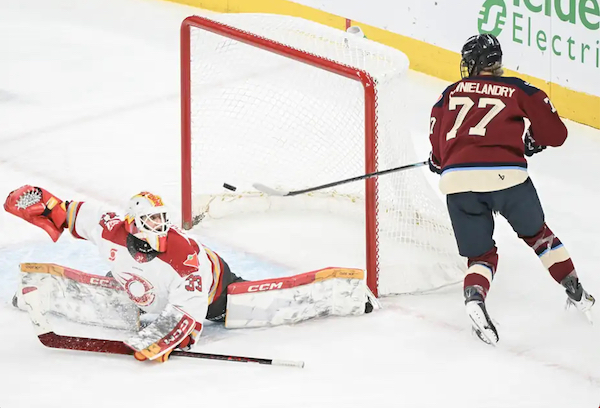
We join the 2025-26 PWHL season already in progress. The Vancouver Goldeneyes visit the Ottawa Charge. The two are seventh and eighth in the league with 12 points each.
This is the league’s third season, as well as Ottawa’s. In Year One they finished fifth and missed the playoffs. Last year they finished third and reached the playoff finals, but fell to Minnesota in a series that went to overtime in every game.
There has been a lot of turnover in the Ottawa squad. This year’s team has fourteen players in common with last year’s, and only five in common with Year One’s: Clark, Hughes, Isbell, Jenner and Mrázová. The Goldeneyes have four players from last year’s Ottawa squad: Bell, Maschmeyer, Schneider and Vanišová.
Rebecca Leslie is the only Ottawa Charge player who is actually from Ottawa.
Ottawa’s top scorer is Brianne Jenner with 10 points; Vancouver’s is Claire Thompson with 7.
The City of Ottawa and Ottawa Sports and Entertainment Group, who own the CFL team and the Ottawa 67s, have cut a deal to rebuild the Lansdowne Park* north stand with a 5,850 capacity hockey rink inside. The Charge were out of this decision-making loop, but the PWHL brass have stated that the club will not play in a smaller rink than the one they have now. Whether that means relocating to the Palladium* in Kanata or to a big stadium in another city like Quebec remains to be seen. (*Rely on me to use the old names for things.)
The Goldeneyes play at the Pacific Coliseum, built in 1968 and the Canucks’ home until 1995. It seats 16,000.
[Ottawa 4, Vancouver 2.]

The Leafs visited the Ottawa Auditorium on this date in 1931. They were third in the Canadian Division with 21 points. The Senators were fifth (i.e., last) with 11.
1930-31 was the last season that the Leafs had the Mutual Street Arena as their home rink. They moved into Maple Leaf Gardens in November 1931. The Mutual Street Arena was built in 1912 and seated 7,500. After the Leafs moved out it continued as a multi-use venue and was not demolished until 1989. The Leafs played under the name Toronto Arenas in the 1918-19 season.
The Leafs’ roster was heavy on Ontario talent, with fourteen Ontarians, two Americans, and one each from Quebec and Manitoba. Charlie Conacher, Busher Jackson, Red Horner, Bob Gracie and Alex Levinsky had all played for the Toronto Marlboros. Ace Bailey and Joe Primeau were former Toronto St Mary’s players. Harold Cotton and Babe Dye had played for Toronto Aura Lee.
Conacher, Jackson, Bailey, Primeau, Horner, Dye, Hap Day and King Clancy all went on to the Hockey Hall of Fame.
King Clancy had played nine seasons for the Senators when he was traded to Toronto in 1930. He was a Leaf for seven seasons before moving up to coach the team. You may remember him as Harold Ballard’s sidekick in the 1980s. He played for St Brigid’s in his early days in the Ottawa City League.
The Leafs’ Rolly Huard appeared in only one NHL game, on December 13th, 1930, against Boston, but he scored a goal. He had played for the University of Ottawa and the Montagnards in the Ottawa City League.
First period: goal by Baldy Cotton (Toronto).
Second period: goals by Hec Kilrea (Ottawa), Danny Cox (Ottawa) and Busher Jackson (Toronto).
Third period: no scoring.
Overtime: no scoring. In those days the NHL had regular season overtime in the event of a tie, but if no one scored the tie stood.
Final score: Ottawa 2, Toronto 2.
Montreal Senior Group:
Game 15, December 22: McGill 0 – 1 Canadiens
Game 16, December 22: Montreal AAA 3 – 2 Victorias
Game 17, December 29: Montreal AAA 3 – 1 Canadiens
Game 18, December 29: Victorias 4 – 1 Columbus
Game 19, January 5: Victorias 0 – 3 McGill
Game 20, January 5: Montreal AAA 1 – 1 Columbus

Sparta Prague. Source.
It’s the Spengler Cup, the annual invitational tournament hosted by HC Davos in Switzerland and played from Boxing Day till New Year’s Eve. Six teams take part; this year they are host Davos, Team Canada, US College Selects, Sparta Prague, HIFK and Fribourg-Gottéron. The teams are divided into two groups, each group plays a round robin and the standings from the round robin determine the playoff positions. The games are:
Group Torriani:
Match 1 (December 26) Fribourg-Gottéron [5 – 2] Sparta Prague
Match 3 (December 27) HIFK [1 – 4] [Sparta Prague]
Match 5 (December 28) [Fribourg-Gottéron] [4 – 3] HIFK
Group Cattini:
Match 2 (December 26) Team Canada [3 – 2] US Selects
Match 4 (December 27) Davos [3 – 5] [US Selects]
Match 6 (December 28) [Team Canada] [1 – 4] Davos
Quarter-finals:
Match 7 (December 29) [Sparta Prague] [5 – 1] [Team Canada]
Match 8 (December 29) [Davos] [3 – 0] [HIFK]
Semi-finals:
Match 9 (December 30) [US Selects] [5 – 3] [Sparta Prague]
Match 10 (December 30) [Fribourg-Gottéron] [1 – 3] [Davos]
Final:
Match 11 (December 31) winner [US Selects] [3 – 6] [Davos]
The Spengler Cup was first played in 1923, which would make this the 103rd edition, except that there were six years when it wasn’t played due to war or some other thing, making this the 97th edition.
Despite being host club, HC Davos have not played in every Spengler Cup, but they have won the tournament 16 times. They are currently in first place in the Swiss National League by a wide margin.
Team Canada first attended the tournament in 1984 and have won it 16 times. The squad is made up chiefly of Canadians playing in the Swiss league or the AHL.
The US College Selects appear for the first time. But it’s not the first time university players have participated. Oxford University won the inaugural Spengler Cup in 1923.
Sparta Prague have been to the Spengler Cup ten times before and have won it twice. They are currently second in the Czech Extraliga.
Fribourg-Gottéron play in the Swiss National League. They won the Spengler Cup last year. They are presently second in the NL.
HIFK from Helsinki have been to the Spengler Cup four times before. Currently they’re 13th in the Finnish Liiga.