
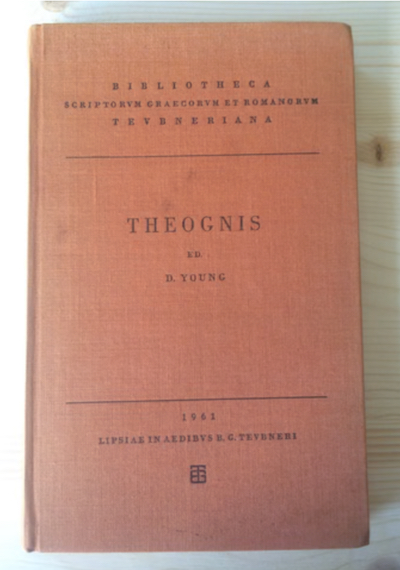
Translated from Young’s Latin preface to the Teubner Theognis (1961), pages VII to IX:
When I undertook to publish the relics of Theognis, I thought it worthwhile to review from scratch as many of the handwritten books as are extant. I was able to eliminate forty-five codices that I had come across, considering each of the readings individually, about which the benevolent reader may see my small work, “A Codicological Inventory of Theognis Manuscripts, with some remarks on Janus Lascaris’ contamination and the Aldine Editio Princeps”, Scriptorium 7, Brussels 1953, 3 – 36. [Link.]
Five codices remain independent, and I have discussed in more detail how they are related to each other in La Parola del Passato 42, Naples 1955, 197 – 214, and I will briefly explain them here:
A — codex Paris Bibl. National. Suppl. Gr. 388 (formerly at the ancient Biblioteca Capitolare in Verona, incorrectly named ‘Mutinensis’ by Bekker), parchment, octavo, early 10th century, folia 46r-75v, having verses 332ab, 1231-1389, omitting 985s. Theognis’ elegies are followed by folia 75v – 80r Phocylides, copied by the same scribe (M). To Theognis verses 1-256, 269-74, 1231-6 and to Phocylides a continuous interlinear version was added by a Latin hand, about the year 1200 (according to E. A. Lowe), which hand (A2, M2) here and there adds or changes breath and accent, here and there emending or (to use the word more insolently) immending the Greek. With Bekker’s first edition in 1815 several letters were erased, which are now not always noted as missing. A tenth-century scribe appears faithfully to have produced a good copy of Theognis, which may have been the first of the Photian Renaissance, when with the rebirth of humane literature older texts were recast [he employs the Greek word metacharakterismos] into what can be called a minuscule cursive script.
O — codex Vaticanus gr. 915, paper, large format, written before 1311, folia 25v-34r. This appears to be an apograph of a lost manuscript found about the year 1300 in the Chora monastery. I think the lost Chora MS was either a twin of codex A or closely related. In copying the codex of Chora, the O scribe included about thirty readings which either the abbot Maximus Planudes or some other learned man of the Palaeologus era had inserted by conjecture. It should be noted that this Vatican. gr. 915 is in Theocritus (where M is named) largely from the Planudean codex. Guilelmo Studemund in Ind. lect., Vratislav, 1889, rightly warned, however, that codex O was produced by its scribe ‘either for his own use or for the use of some poor learned man’. Codex O, copied hastily and less accurately from a fairly good copy, is full of nonsense and must be considered of far less authority than codex A.
X — codex London, British Museum, Additional 16, 409, paper, large format, folia 76v-85r, a witness long neglected. X is copied from a now lost apograph which Maximus Planudes had written in his own hand on several parchment folia torn from the celebrated Vent. Marcia. 481, which contains the Planudean Anthology he edited. I have demonstrated that codex X was written before the death of Planudes about the year 1305. From the same lost copy of Planudes two apogonoi are derived, of lesser importance indeed but not to be completely discarded, Ur and I.
Ur — codex Vatican. Urbinas gr. 95, paper, octavo, folia 81r-83r, containing verses 1-276, from about year 1430, in the hand of John Eugenikos.
I — codex Venet. Marcian. 774, paper, quarto, folia 210v-234v, from about the year 1450, in the hand of John of Docea.
The Planudean group X Ur I has the least authority, as Planudes has changed many aspects of Mars, or even more of his fat Minerva. At the same time he corrected some minor errors with his easy conjecture, as was his way. O X Ur are written in two columns. X Ur I distinguish opinions variously. The apograph of O is K (Ven. Marc. 317), a text overflowing with conjectures. The apograph of Ur is codex U (Monacens. gr. 495), of no value. The rest, as many as I have cited, and also the first Aldine edition in the year 1495/6, depend on codex X. Of these, you can see below a list of the genealogies and codices. Of the other witnesses, John Stobaeus is to be trusted in the first place, who offers many varying readings, and who alone has preserved certain epigrams, as well as other versions of certain epigrams, which I took care to print among the doubtful fragments (p. 84s).
In slippery matters pertaining to dialect and orthography, I have generally followed either the consensus of the codices or the authority of the best codex A. For I doubt whether the Megarian poet was accustomed to adhering to certain rules.
Classicist Douglas C. C. Young is an interesting figure. As leader of the Scottish National Party during World War Two he did jail time for claiming that only a Scottish government could legitimately send Scottish soldiers to war.

