
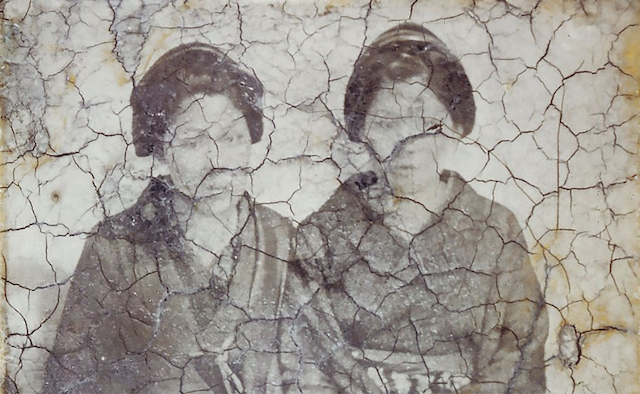
Ukai Gyokusen was one of Japan’s earliest photographers. He ran a photographic studio from 1860 or 1861 to 1867, specializing in portrait photography using the wet plate collodion method on glass plates. Several years before his death in 1887 he buried over two hundred of the plates in the ground beside his family burial plot. In 1956 the site was excavated and the photographs recovered. They were in bad shape. BBC.
Yasunari Kawabata’s novel Beauty and Sadness came out in serialized form from 1961 to 1963. In the chapter “Strands of Black Hair” the characters discuss the opening of the tomb of the young wife of the 14th shogun, Princess Kazunomiya, who died in 1877. A glass photograph was found on the body, containing the image of a young nobleman. But within a day the image had faded completely from exposure to the air and light. Kawabata’s characters speculate about the identity of the courtier — husband or lover? — and are struck by this example of the fleeting nature of human life.
You might think that Kawabata took the 1956 discovery of the two hundred plates and transformed it into the story of the princess, but in fact the excavation of her tomb and the discovery of the fading image really happened in 1950. Source.
I don’t know if Ukai Gyokusen is thought to be the photographer who created the princess’s keepsake. But if indeed it was a picture of her husband, Ukai was in the right town (Edo) at the right time (Kazunomiya and Tokagawa Iemochi were married from 1862 until 1866).
 atonofsnow.com